
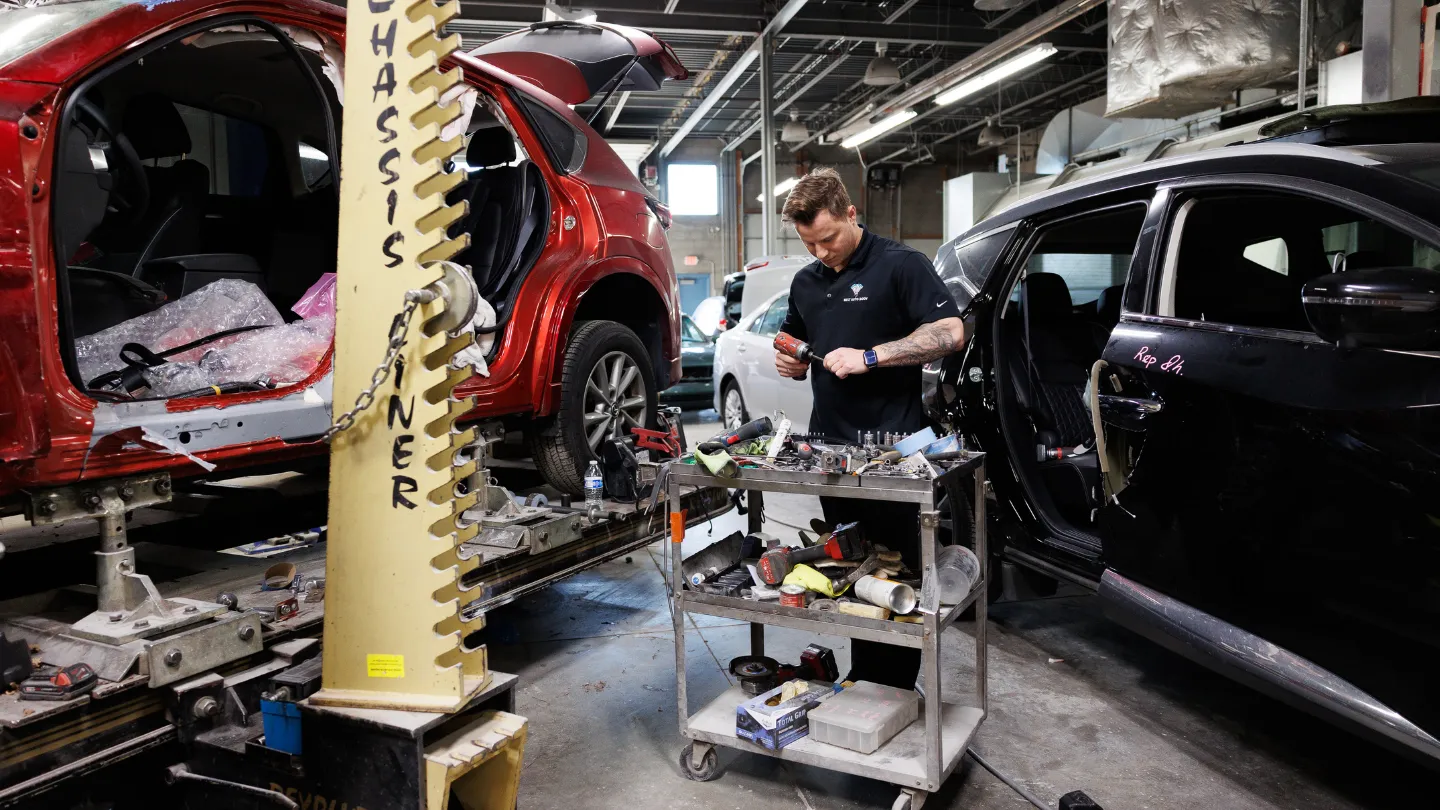
Few phrases scare a vehicle owner more than "your car has frame damage." It sounds like a death sentence, but for most modern vehicles it isn’t. Today’s body shops have laser-accurate measuring systems, hydraulic frame racks, and decades of refined technique that can return a damaged structure to factory specifications. The real question isn’t whether frame damage can ever be repaired; it’s whether the specific damage on your vehicle can be repaired safely.
Full-Frame vs. Unibody: Why It Matters
There are two main vehicle structures on the road today. Full-frame vehicles (most pickups, body-on-frame SUVs like the Wrangler or 4Runner) have a separate steel ladder frame underneath the body. Unibody vehicles (almost every car, crossover, and modern SUV) have the body and frame integrated into one welded structure made from various grades of steel and aluminum.
The repair philosophy differs. On a full-frame truck, sections of frame can sometimes be cut, sectioned, and re-welded per OEM procedures. On a unibody, the structure is engineered as one designed-to-deform crash absorber, and repair must restore both the geometry and the original metallurgical integrity.
How Modern Shops Measure and Restore Frame Geometry
The first step in any frame repair is measuring. A shop pulls the vehicle onto a frame rack and uses a laser or three-dimensional measuring system to compare actual dimensions against the manufacturer’s spec at hundreds of reference points. The system reports millimeter-level deviation, showing exactly where the structure is bent, twisted, or shortened.
From there, hydraulic pulls slowly straighten the structure under controlled tension, with the measuring system live-monitoring the geometry as it returns to spec. This is precision work; over-pulling can introduce new problems, and metallurgical limits matter (high-strength steels and boron sections cannot be straightened beyond certain thresholds without weakening).
When Frame Damage Is Truly Beyond Repair
Some damage genuinely should not be repaired. Tears in structural rails, intrusion of damage into a B-pillar (the post between front and rear doors), severe cabin deformation, or damage to designed crumple zones that have already absorbed impact mean the structure can no longer be guaranteed to perform in a future crash. Manufacturers publish hard-and-fast no-repair zones in their service procedures.
If your vehicle has damage in those zones, an honest shop will tell you it should be totaled rather than attempt a cosmetic repair on a compromised structure.
Conclusion
Frame damage isn’t automatic for the junkyard. With proper measuring, the right equipment, and a technician who follows OEM procedure, most modern unibody and full-frame vehicles can be safely returned to factory specifications. Ask your shop for a post-repair measurement printout; that piece of paper is the proof that the structure is back where it belongs.
Best Auto Body in Blaine performs frame measurement and structural repair using laser-guided systems and follows OEM procedures on every job. Call (612) 272-7822 or visit bestautobodyllc.com if you have been told your vehicle has frame damage.